By Deann Marin at The Best of Teacher Entrepreneurs

As much as I love seeing those smiling faces each year, I always get a bit sad when the summer ends and I have to go back to work. I get so spoiled, getting up in the morning and doing whatever I want. No alarm clock to wake me up, no set schedule, I can stay up late, go out and party during the week, no rules, no lesson plans, no prep. It’s so easy to get used to that. Don’t you agree. This summer I’ve decided to make life a little easier for myself and teachers out there by putting together a few items that will just make your job so much easier.
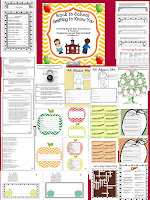
Here are a few lessons that I’ve included in my “Getting to Know You,” Back to School Bundle. Something that you shouldn't go back to school without. You'll love my chevron apples for the names of your students, if they're little you can pin the little apples on each child to help you remember their names. You might want to place the larger chevron apples on the bulletin board, under a tree.
Once my homeroom gets settled and we've taken care of those tedious little tasks, like filling out forms and schedules it’s time for some ice breakers, we need to get to know each other. I play “Getting to Know You,” from Rogers and Hammerstein's, The King and I. Next we discuss the meaning of the song and how it relates to the first day of school.
1. Play the song, “Getting to Know You,” from The King and I. A YouTube Link and lyrics are included.
2. Talk about the song and ask them how they get to know someone.
3. Pass out Getting to Know You cards and have each child pick one. They will answer the question about themselves. The Teacher should also pick a card. and answer it, hat will help them to get to know you. too.
4. Want to make sure they are listening, you could have the class repeat something
that they learned about each other.
Example for younger children
Teacher answers 1st question, Rachel is the 1st student, she repeats teacher’s
question and answers it, then Rachel has her their turn to answer the
question.. Josh is next he repeats Rachel’s question and answers it, he then
answers his own question.. You continue this way till everyone has had their turn.
Example For or older children
Begin the same way as you would for younger children. When Josh has his turn, he has to repeat teacher’s Rachel’s question and answer, before heanswers his own question. As game continues, each child has more and more to remember. At the end, you should try it.
Oh,
One more thing, as if this isn’t enough, they have to say each other’s names and
then say the question and answer before they can read and answer their
question. If this is too difficult, just have them repeat all the names of the students before them.
Another tip for remembering names is to keep your seating chart in front of you. It’s a great ally until you know all of their names.
For me, the next task at hand is opening lockers which is a very challenging activity. I’m sure to have one or two sixth graders in tears. There is an image of a locker with directions on how to open them, you can make a copy for each child.
Homework Options you can use all of the worksheets or just a few. it’s up to you.
1. Have students answer questions about themselves in complete sentences and make sure they use correct grammar.
2. For younger children, I’ve included 4 all about me pages They are to answer questions about themselves and color in the picture of a boy or girl and make the eyes and hair the same colors as their own. Two pages are in color and two pages are black and white.
3. There are 7 writing prompts To help you begin to assess the writing skills of your class. A grading rubric has been included for your convenience.
4. Family tree, I’ve included 8 trees depending on the size of each child’s family. Before you
pass out the trees ask them how many people are in their family and give them the
one with the correct amount of ovals. They can include grandparents, aunts, uncles,
cousins, if they like. They are to either draw the family member’s picture in the oval, or use a photo., then write name of the person in the box underneath the picture.
5. As a bonus, I’ve included a Back to School Crossword Puzzle with an answer sheet.
*********************************************************
 |
| Behavior Modification |
Another bundle that has earned the name Don’t Go Back To School Without, is my Behavior Modification Bundle which will make your life much easier. It has everything that you could possibly need to help achieve the type of behavior that is optimal for learning.
Here are some of the lessons that I’ve included.
1. Daily Point Sheet
This was used for special education classes. It can also be used for any grade. Fill in the subject, activity or time, at the end of the period put a smiley face, sticker or check mark in the box if the goal was met. You could also give each task a number equivalent, that way if they child pays attention for some of the time, he could still earn credit for being on task part of the time. That way he/she will not give up. You could make each category worth 5 points, or what ever you think is appropriate for your class. Included is a blank form for you to fill in yourself with your own goals and subjects.
2.. Time or Subject Card Instructions
This was used with special education classes. Tape card/paper to each desk. When child behaves appropriately, attach a colored star (it can be handmade), sticker, checkmark, or whatever you’d like. Do this every 15-20 minutes. At end of day add it up and child earns a pre-determined reward for a certain number of stars.
3. Daily Behavior Form for Primary Grades
Just like a traffic light. Green means go, orange means caution, and red means stop. Circle the appropriate colored oval. Green is for good behavior, Orange is for caution, not the best choice, and red means poor decision.
4. Weekly Behavior Chart for Teacher and Child to Fill Out
It is so important for children to learn that they need to be responsible
for their own actions, that’s why this worksheet is useful. Very simple circle the number that corresponds with behavior. 5 is great, 1 is poor. The child may fill out his/hers, the teacher may fill it out, or both the child and teacher can fill it out. There is a spot for comments as well as signatures from the teacher and the parent.
5 Weekly Behavior Chart
Before you introduce this chart to the class, you should discuss the desired behaviors, the highest amount of points they can earn for each subject/activity or time period, and the amount of points needed by the end of the week for their desired reward.
For example, you may decide the children can earn up to 10 points, you can give them less, depending on their behavior. Each chart has a place for their name at the top, a section for subjects/times, and a place to put the points earned for that particular activity. At the bottom the child will write how many points they need for the particular reward that they would like. You have 6 activities each day, they can get 10 points for each. They can earn 60 points per day and 420 by the end of the week.You will have to decide ahead of time how many points each reward is worth. Discuss rewards with the class and see what they would like.
One Free Homework could be worth at least 375 points
Computer time 275 points
Board games 325 points
Chewing gum in class 400 points
Movie 400 points
6. Class Reward Chart. I’ve included two class reward charts for you to keep track of the rewards used. There is room to write the names of the students, I’ve left a blank space, next to points for you to fill it in yourself. That way, the class will know how many points everything is worth and they won’t have to bother you about it. When the child uses his/her reward, put the date. That’s it.
7. Problem Solving Worksheet
I’ve already mentioned how important it is for children to learn responsibility for their
actions. Two worksheets are included that address this. The first one can be used with younger children. The child is to write about a problem that has occurred between himself/herself and another child. Not only focusing on the negative but the positive, they are asked how they could have handled the situation better, and what they have learned from it. The second worksheet is for older students, they are asked to tell their side of the story, and how they could have handled it better. These worksheets are given to all children involved in the incident. If the child has an issue with another adult, they can use this for that also.
8. Incident Report
As a final recourse, this form is for the teacher to fill out. It should be kept as part of the student’s record and may be copied to give to the principal and sent home to the parent.
9. Happy Grams
So many times the only notes that are sent home are negative, that’s why I’ve created Happy Grams for any type of good behavior. I’ve included a few letters for different subject areas and good behavior, plus a blank one for you to fill in.
10. Detention Notices to Parents
Last of all, there are 5 types of detention notices if you want to keep a child after school as a consequence for their actions. This will give you some time to speak with the child and find out what is going on. That way the child will know that you care, you are taking the time to talk. Sometimes just one detention is all it takes.
If you’d like to have the worksheets that go with the rest of these activities please visit my Tpt Store.
I hope that this post has helped to make the beginning of your school year a bit easier.
Best of luck to you..
Deann
*********************************************************
Please visit Socrates Lantern’s Social Media Sites
Don't Start the School Year Without Taking a Look at these Great Blog Posts from my Fellow Teacher Collaborators.